
 ALIBABA 13+ YRS
 GLOBAL SOURCE
Blog
The Zero-Waste Rattan Factory: How OEM/ODM is Turning Bamboo and Rattan Scraps into High-Value Composites

10
Dec
Dec
In the world of mass production, “waste” is often accepted as the cost of doing business. But in the lush heartlands of Vietnam, where the tradition of weaving runs deep, we see things differently. For us, every strip of bamboo and every vine of rattan represents a resource that nature took years to perfect.
As a premier Bamboo serving tray manufacturer, our philosophy goes beyond simple aesthetics; it delves into the very efficiency of how materials are used. The modern OEM (Original Equipment Manufacturer) and ODM (Original Design Manufacturer) landscape is shifting. It is no longer just about who can make it the fastest, but who can make it the smartest. By integrating zero-waste principles into our manufacturing lines, we are turning what would be “scraps” into intricate, high-value composite details.
The Art of Precision: Maximizing Every Fiber
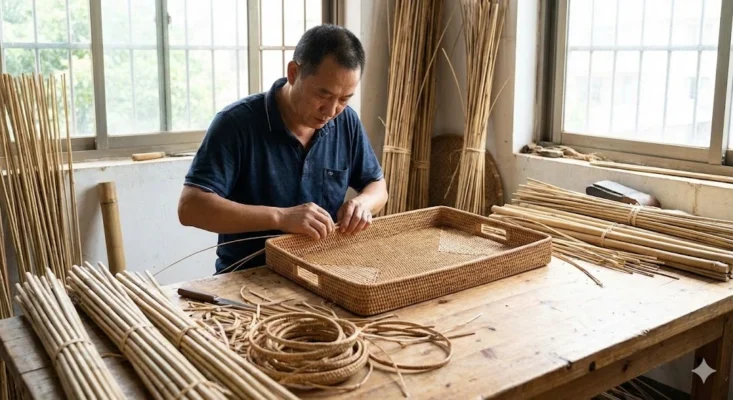
When we craft large-scale items, the focus is often on durability and structure. Take, for instance, our handwoven rectangular trays with a solid wood base and sturdy handles. The production of these robust pieces requires premium, long-fiber rattan to ensure longevity.
However, the precision cutting required for these bases often leaves behind shorter, yet perfectly high-quality, off-cuts. Instead of discarding these, our ODM team reimagines them. These shorter strips are ideal for finer, detailed work. They find new life in products that require intricate dexterity rather than structural length, such as the delicate rectangular serving trays featuring a wavy edge and geometric block pattern. By designing our product lines to complement each other, the “waste” from one line becomes the raw material for another.
From Scraps to Sophistication
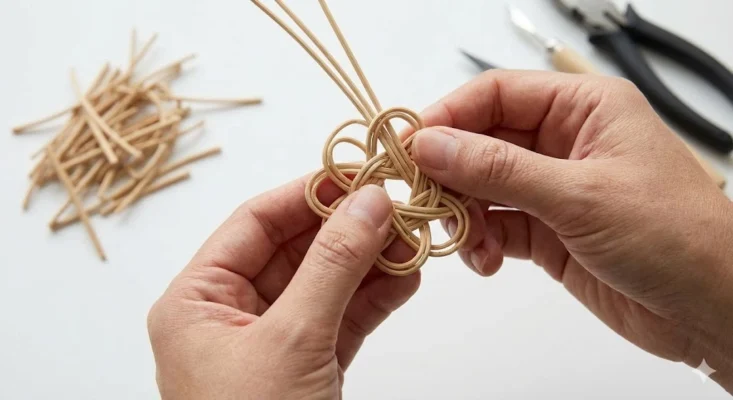
This zero-waste approach allows us to offer a diversity of textures and weaves without increasing our raw material footprint. A prime example of this efficiency is our brown long rectangular tray with a fine weave finish. The uniformity required for this fine weave demands rigorous sorting of materials. The strands that don’t meet the specific length or color uniformity for these large trays are not thrown away.
Instead, they are perfectly suited for our rustic and decorative accessories. These so-called “imperfect” strands are woven into charming, small-scale items that celebrate natural variation, like our light brown handmade rustic basketweave napkin rings. Here, the varying tones of the fiber add character rather than being seen as a defect.
Furthermore, the most flexible and thin off-shoots of the rattan vine, often too pliable for heavy-duty trays, are spun by our most skilled artisans into complex shapes. These become our exquisite handwoven floral rosette straw rattan napkin rings, proving that the smallest materials often hold the greatest artistic potential.
Your Strategic Partner in Sustainable Sourcing
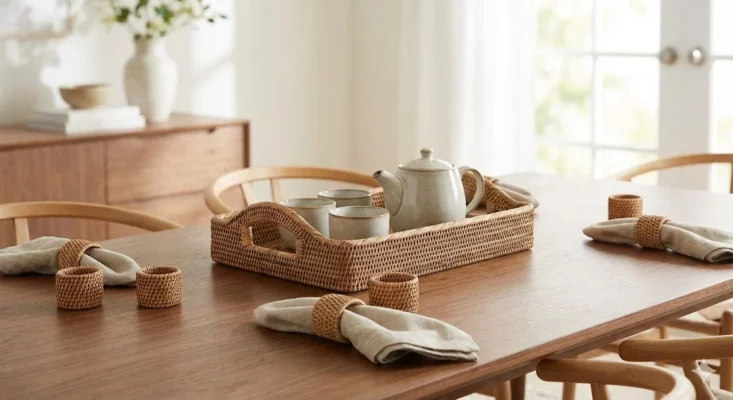
As a Rattan basket wholesale supplier, we understand that global brands are under increasing pressure to prove their sustainability claims. Sourcing from a factory that actively reduces waste doesn’t just look good on a CSR report—it ensures price stability and material availability.
By utilizing the full potential of our natural resources, we bridge the gap between artisanal heritage and industrial efficiency. This balance is something we explored deeply in our previous discussion on The Uncompromised Standard: Marrying Handcrafted Perfection with OEM Precision.
Whether you are looking for a bespoke ODM design that utilizes reclaimed manufacturing scraps or a standard OEM production run, our facility is equipped to deliver fully natural, zero-waste solutions that compromise neither on quality nor conscience.
